 Kusama
 staking fit, trade-offs and exit timing
Kusama staking fits KSM holders who can accept variable rewards, validator-linked slashing exposure and a seven-day unbonding delay before the account regains a transferable balance. Solo nomination gives the account holder control over validator choices, although reward eligibility depends on active backing and a changing stake threshold. A nomination pool combines member stake and delegates validator selection to its administration, which may charge commission. Anyone facing a fixed spending deadline should plan the exit before bonding KSM.
In short: Plan the seven-day KSM unbonding window before staking, then choose solo nomination or a pool by control, eligibility and commission.
From a signed stake to active validator backing
An eligible KSM balance becomes a staking position after the account bonds value and records either validator nominations or pool membership on Kusama Asset Hub. Balances, staking and governance moved there in October 2025, while the Kusama Relay Chain kept its security role. Many supported wallets select the relevant chain automatically. An advanced interface may require an explicit Kusama Asset Hub connection. Keep some KSM free for transaction fees because the bonded portion is not transferable.
After signing, inspect the finalized account state rather than relying on a confirmation screen. Solo nomination must show an active allocation to a validator before it can earn rewards. A pool member earns only when the pool's stake actively backs a validator that earns rewards. A recorded bond confirms that KSM is locked, but it does not establish reward eligibility without active backing. Elections can leave selected validators waiting, so activation may occur only in a later era.
Solo nomination and pools assign control differently
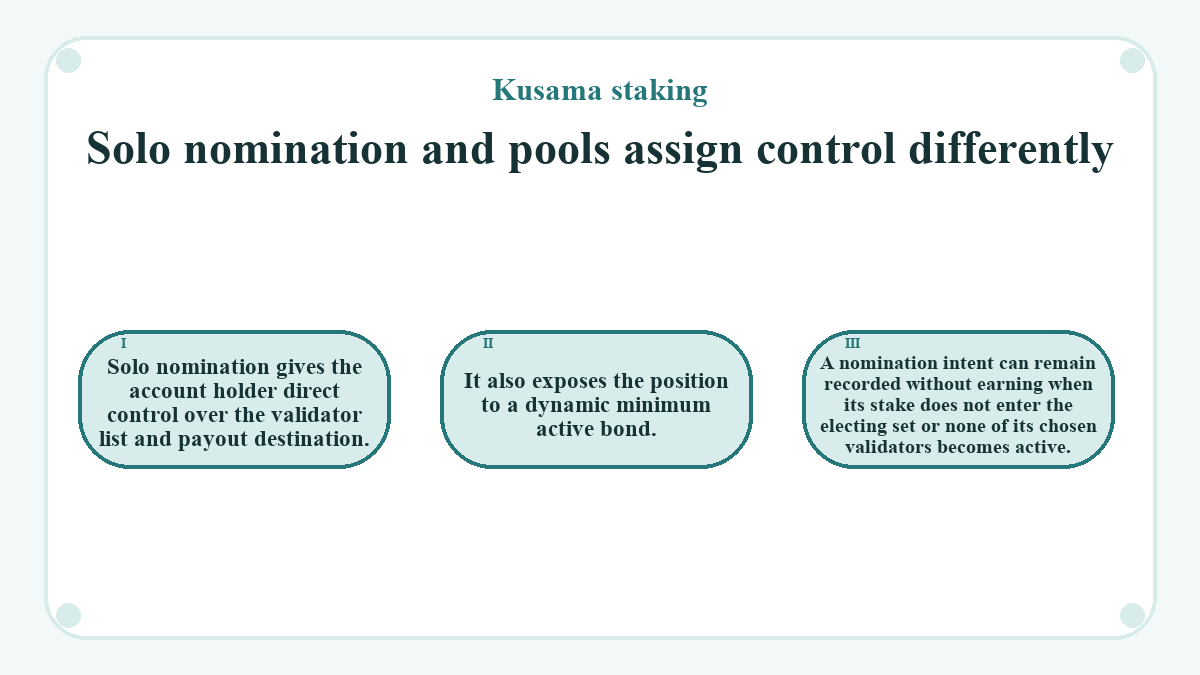
Solo nomination gives the account holder direct control over the validator list and payout destination. It also exposes the position to a dynamic minimum active bond. A nomination intent can remain recorded without earning when its stake does not enter the electing set or none of its chosen validators becomes active.
An on-chain nomination pool combines member stake and appears as one nominator to the Nominated Proof of Stake election system. The pool administration selects validators, while members retain the ability to unbond their positions. Pool performance still depends on active backing. Members also accept validator commission and any separate pool commission deducted from earned rewards.
- Compare the solo position with the displayed dynamic active threshold.
- Read the current validator or pool commission before signing.
- Inspect the selected validators, active status and slash history.
- Choose whether rewards stay claimable or return to bonded stake.
- Reserve enough free KSM for management and withdrawal transactions.
Pools generally fit a smaller balance or an account holder who does not want to maintain a personal validator set. Solo nomination fits someone prepared to monitor nominations and adjust them. Neither route promises rewards, and both expose active backing to protocol slashing.
When does staking fit a time-sensitive plan?
Staking fits a time-sensitive plan only when KSM can remain unavailable through unbonding and the later withdrawal transaction. Kusama applies a seven-day unbonding period before normally unbonded KSM can be withdrawn as a transferable balance.
Rewards do not accrue on the unbonding portion during that wait. When the countdown ends, a separate withdrawal action is still required before the unlocked KSM appears in the free balance. A sale, transfer or payment deadline inside the normal window makes bonded KSM a poor funding source. Market movement during the wait also changes the fiat value that the released tokens may carry.
The current Kusama Asset Hub staking runtime does not provide a fast-unstake path. Solo nominators can generally rebond during the wait. Pool members cannot rebond while unbonding and must finish their exit before switching pools.
A hypothetical deadline test for 1.73 KSM
All changing inputs in this example are hypothetical: 1.73 KSM, a solo-nomination starting route and a payment deadline chosen by the reader. The current protocol conditions are the normal seven-day unbonding period and the absence of a fast-unstake path.
If the deadline leaves more than the unbonding period plus time to sign the final withdrawal, the account must submit the unbonding action early enough for the unlock point and final withdrawal to occur before the deadline. The first evidence is a finalized extrinsic and an on-chain unbonding entry for 1.73 KSM. After the entry reaches its unlock point, a withdrawal action moves the eligible amount into the free balance. The free balance then shows the withdrawn KSM, which confirms completion. Rewards stop on the amount in unbonding, and any applicable slash can still affect it.
If the deadline arrives before the unlock point, repeated submissions cannot shorten the wait. The recorded unlock point still determines when withdrawal becomes possible. Inspect the recorded state before retrying because another submission may only add a fee. Under the hypothetical pool route with the same balance and deadline, the normal wait still applies, rebonding is unavailable and full withdrawal ends the membership. Changing routes therefore does not solve the timing constraint, although solo nomination preserves the rebond option.
Active backing and commission shape reward variability
Reward outcomes change with election status, validator performance, total backing and commission. After validator commission is deducted, the remaining era reward is divided pro rata among the validator and the nominators whose stake backed it.
Active validators receive broadly comparable era rewards for comparable work, so heavier backing can reduce the reward per staked KSM. Era points add variation between validators. A nomination waiting outside the active set earns nothing for that era. Historical annualized percentages compress these changing inputs into one estimate and cannot establish a future payout.
Pool members may face both validator commission and a separate pool commission. These deductions apply to rewards rather than bonded principal. Someone must trigger solo reward payouts, although the validator often handles that action. Compounding occurs only when a claimed reward returns to bonded stake through the selected payout setting or pool action. A growing KSM balance can still lose fiat value when the token price falls.
Slashing and custody set the final boundary
Slashing is the main risk that distinguishes native staking from merely holding liquid KSM. In Nominated Proof of Stake, a validator and the stake backing it can lose KSM for slashable conduct. The amount depends on the offense and the account's exposure. A pool spreads administrative work, but it does not shield members from the consequences of its validator choices.
Checking validator records can help identify warning signs, but it cannot eliminate slashing risk. On-chain identity, commission, self stake, prior slashes and active performance provide different information about a validator. A low commission does not offset a poor operating record. Pool members should inspect the pool's nominees because its administration controls that list.
Native staking leaves signing authority with the account holder rather than a validator or pool operator. That custody boundary does not protect against a compromised wallet or deceptive signature request. Read the chain, call and amount shown by the signer before approving a bond, nomination, unbond or withdrawal.
An unbonding request does not erase exposure that arose while stake backed an active validator. A later slash can reduce the amount that eventually unlocks. Keeping KSM liquid avoids validator-linked slashing and the seven-day exit delay, though liquid holdings receive no native staking rewards. Staking fits when potential rewards and participation in network security justify accepting both constraints.
Still wondering about Kusama staking?
Can I change validators without starting a Kusama staking exit?
Yes. A solo nominator can submit a new validator selection while its KSM remains bonded. The election process determines when the changed nominations become active. A pool member does not choose validators directly because the pool's nominator role controls that list. Moving to another pool requires unbonding, withdrawing the unlocked KSM and joining the replacement pool.
Does chilling a nominator unlock bonded KSM?
No. Chilling schedules the account's nomination intent to stop in the next era but leaves its KSM bonded and unavailable for transfer. The account must submit an unbonding action, wait through Kusama's seven-day unbonding period and then withdraw the unlocked balance. Chilling can therefore stop further active nomination without completing the financial exit.
Why did rewards stop even though my KSM remains bonded?
Bonded KSM earns only when the solo position or pool stake actively backs a validator that earns rewards. Solo rewards can stop when nominations remain waiting, the position falls below the dynamic active threshold or its stake does not actively back a selected validator. Pool rewards can stop when the pool no longer backs an active validator. Validator commission can consume the distributable reward on either route. A pending payout can also make earned rewards appear absent until someone triggers it.
Can one Kusama account nominate solo and join a nomination pool?
Yes. The current staking setup allows one account to maintain a solo nomination position and a pool membership. Each position has its own bonded amount, activity status and reward handling. The account still needs a free balance for fees, and eligibility shown for one route does not establish that the other route is actively earning.
Are nomination pool rewards compounded automatically?
No, pool membership alone does not activate automatic compounding. Rewards accrue as claimable value, and the member can withdraw them or bond them back into the pool. To let another account compound the rewards, the member must choose a claim permission that allows permissionless compounding. That permission authorizes the action but does not schedule it automatically.
Is fast unstaking guaranteed when no staking rewards arrived?
No. Missing rewards may reflect waiting nominations, a pool without active backing, commission or an untriggered payout rather than an absence of active exposure. The current Kusama Asset Hub staking runtime does not provide a fast-unstake path, so a solo-staking exit requires the normal seven-day unbonding period and a final withdrawal.
Last updated